

Wood vs. Lumber

While many use the terms wood and lumber interchangeably, there are differences. Wood often refers to different species of trees and the raw timber companies harvest from trees. Lumber typically refers to processed boards and sheets ready for use in construction, woodworking and other projects. Lumber is available in various forms, sizes, types and cuts.
Wood and Lumber Characteristics
Understanding key wood characteristics will help you choose the best lumber for your project.
Wood Density
- Denser wood is best for furniture and building.
- Less dense wood can be useful for projects like making picture frames, shelving and craft projects.
Wood Texture
- A rough texture has a more rustic look and accepts stain and sealer better.
- A smooth texture looks more refined but doesn’t absorb finishes as easily.
Wood Color
- The natural color of a wood affects how wood stains affect the final look or if a stain is necessary.
- Darker shades have a more elegant appeal, while lighter tones create a casual feel.
Woodgrain
- A board with straight, tight woodgrain is generally the strongest and best for structural projects.
- Grain with varying characteristics adds beauty and character to decorative projects.
Types of Wood
Wood is either hardwood or softwood. Our hardwood and softwood guide has details on each type with examples, benefits and considerations, and common uses. Here are the basics.

Softwood Quick Facts

Types of Lumber Products
Lumber suppliers process wood into a variety of products, from solid wood boards to sheets of engineered wood. Here are the most common types of lumber that can be used in a variety of DIY and construction projects.
The suitability of different lumber types and sizes for building applications varies by building code. Follow the code for your area. Wear safety glasses, hearing protection and a respirator when cutting wood. Wear work gloves when handling treated lumber and don’t burn treated boards or sheets.
Treated Lumber

Pressure treated lumber is saturated with preservative chemicals and intended for outdoor use:
- Treated lumber resists rot and insect damage and can be for above-ground use or ground contact, depending on the treatment.
- Treated lumber needs corrosion-resistant fasteners and hardware, such as those with hot-dipped galvanized finishes, special coatings or those made of stainless steel.
- The wood must dry, sometimes for several weeks or months, before painting, staining or sealing.
- Treated lumber is ideal for exterior construction projects like building fences or decks.
Common Treated Lumber Sizes and Uses
Dimensional Lumber, Studs and Furring Strips

Dimensional lumber, studs and furring strips are three types of framing lumber:
- Dimensional lumber and studs are key framing elements in construction and also useful in DIY projects.
- Exterior exposure requires a weather-resistant finish.
- This lumber is typically not suited for ground contact.
- Furring strips are non-structural components in construction.
Common Dimensional Lumber, Stud Sizes and Uses
- 2-by-4: Wall framing, wall studs, general construction
- 2-by-6: Exterior wall framing, rafters, floor joists
- 2-by-8: Rafters, floor joists
- 2-by-10: Rafters, floor joists, ridge beams
- 2-by-12: Ridge beams, stair stringers, headers for large openings in a structure
Common Furring Strip Sizes and Uses
All sizes of furring strips can create level surfaces for securing paneling and siding to walls and are useful in craft projects.
Plywood, Sheathing and Sheets

Plywood, sheathing and other sheet goods are made from wood materials bound together with adhesives.
Plywood
Plywood sheets are made of thin wood layers glued together.
- Plywood is available for indoor use, outdoor use or temporary exposure to weather.
- Plywood works for projects ranging from construction to furniture making.
Our plywood product guide gives you the details you need to know about this useful construction material.
OSB
Oriented strand board (OSB) is formed by bonding layers of large wood chips with wax and resin.
- OSB is available for interior use or temporary exposure to the outdoors.
- This engineered wood product is common in construction.
MDF
Medium-density fiberboard (MDF) is made by binding wood fibers with wax and resin.
- MDF is only suitable for interior projects in dry areas.
- MDF is often used to make furniture and trim.
Common Plywood, OSB and MDF Sizes and Uses
- 4 feet by 8 feet (Plywood): building sheathing, subflooring, furniture
- 4 feet by 8 feet (OSB): Building sheathing, subflooring
- 4 feet by 8 feet (MDF); Furniture, cabinets and moulding
- 2 feet by 4 feet and 2 feet by 2 feet (Project Panel): Woodworking, crafts and repairs
See our comparison of plywood, OSB and particle board to learn advantages and considerations of each wood product, as well as common uses.
Appearance Boards

Appearance boards are for use in projects that don’t require the lumber to support a lot of weight. This type of lumber is available as hardwood or softwood:
- Appearance boards are for interior or exterior projects, depending on type and finish.
- This lumber is good for woodworking, crafts and trim.
- The boards are available primed or unfinished and ready for stain or for paint or stain.
- Some appearance boards are edge-glued — glued together to create large boards or wood rounds.
Common Appearance Board Sizes and Uses
Lumber Sizes
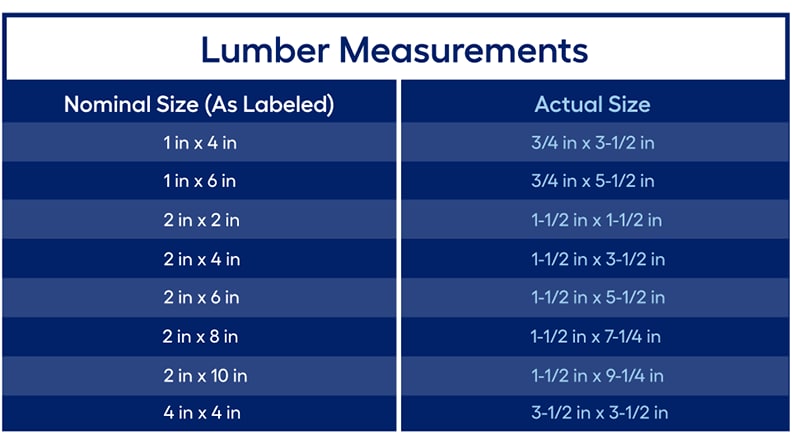
Most lumber sizes are standardized. You might see listings of nominal or common measurements and listings of actual measurements:
- Common or nominal measurements are the lumber’s original dimensions.
- Actual measurements are the approximate dimensions of the lumber after drying, trimming and planing.
- Nominal and actual length are the same and are often listed in feet.
- DIYers and pros typically refer to wood sizes by common measurements.
For example:
- A nominal 1-by-4-by-8 is 3/4 of an inch by 3-1/2 inches and 8 feet long.
- A nominal 2-by-4-by-10 is 1-1/2 inches by 3-1/2 inches and 10 feet long.
- A nominal 4-by-4-by-8 is 3-1/2 inches by 3-1/2 inches and 8 feet long.
Lumber Grades
Lumber typically has grading that tells you about the lumber’s appearance and the number of defects. These grades help you choose the best lumber for different projects.
Hardwood Grades
Hardwood grades are based on the number of defects in a board. Typical grades include:
- First and Seconds (FAS): Minimum 6 inches by 8 inches; 83% usable material on one face
- Select (Sel): Minimum 4 inches by 6 inches; 83% usable material on one face
- Common (Com): Minimum 3 inches by 4 inches; 66% to 50% usable material on one face
Softwood Grades
There are two categories of softwoods grades: dimensional lumber, with a grade based on strength, and appearance boards, which are typically used for woodworking projects.
Typical Dimensional Lumber Grades
- No. 1: Some defects but structurally sound; useful in applications requiring stiffness and strength
- No. 2: More defects and knots than No. 1; common in residential framing
- Stud: The most visible defects; suitable for vertical applications such as wall framing
Typical Appearance Board Grades
- Select: Almost completely clear of defects or knots no larger than the size of a dime; used for interior trim and cabinets
- Common: Has larger knots; used for paneling, shelving and general woodworking or, depending on knot size, fences, boxes and crates
Lower numbers (1 Common, #1, etc.) typically mean higher-quality lumber within a grade.
How to Read a Lumber Grade Stamp

When selecting lumber, look for the grade stamp. Here’s what you’ll see on a typical grade stamp like the image to the right:
- Grade: Lumber grade (ex. 1COM for 1 Common)
- Manufacturer: Mill number, name or symbol (ex. 12)
- Certification Mark: Symbol of the agency providing quality control supervision (ex. WWP®, for the Western Wood Products Association)
- Moisture Content (MC): Moisture level in the wood when it was graded; MC 15 is 15% or less; KD or S-DRY is 19% or less; S-GRN is green wood with more than 19% MC (ex. S-DRY)
- Species Mark: Symbol or abbreviation for tree type (ex. PP for ponderosa pine)
Lumber with lower moisture content is stronger and less likely to warp, shrink or crack.
Lumber Pricing
When calculating the price of lumber for a project, there are several factors to consider:
- Wood species
- Wood size
- Market demand
- Availability
To estimate the cost of lumber:
- Determine the number of boards you need for the project.
- Add 10 percent to account for cuts and mistakes, as well as material for future repairs.
- Multiply the final number by the cost of a board and add tax.
- Factor in the cost of renting a truck or trailer or having the lumber delivered, if necessary.
Key Points on Wood Types and Lumber Types
The right type of wood and the right type of lumber help make your projects stronger, safer and more beautiful. Here’s what you need to remember:
- Hardwood has distinct grain that adds beauty to woodworking and furniture building.
- Softwood is a more economical lumber for many framing and structural projects.
- Treated lumber is necessary for outdoor projects like decks and fences.
- Dimensional lumber and studs are typical for framing inside buildings.
- Plywood and OSB work as subflooring and exterior sheathing.
- MDF is for interior uses like furniture and trim.
- Appearance boards are best for furniture or cabinets.
- Follow building codes when choosing lumber for any construction project.
Shop Lowes.com to find the right wood and lumber for your next project. Or visit your local Lowe’s and get help from a Lowe’s Red Vest associate. They can help you find the right type of lumber, and make sure you have all the fasteners, materials and tools you need for a successful project.
FAQ: Lumber Sizes and Types of Wood
Answers to some common questions about lumber can help you plan and choose the right wood for your project.
How Big Is a 4 x 4?
The actual size of a nominal 4-by-4 is 3-1/2 inches wide by 3-1/2 inches thick. 4-by-4s are available in lengths ranging from 6 to 16 feet.
What Size Lumber Do I Need for Stair Stringers?
Stair stringers are typically 2-by-12 lumber. The width allows you to cut the wood for standard treads and risers while keeping enough of the board to support the stairs. Follow building codes for your area.
What Is Whitewood?
Whitewood refers to several types of softwood, including pine, spruce and fir, that are relatively lightweight with a light wood tone.