
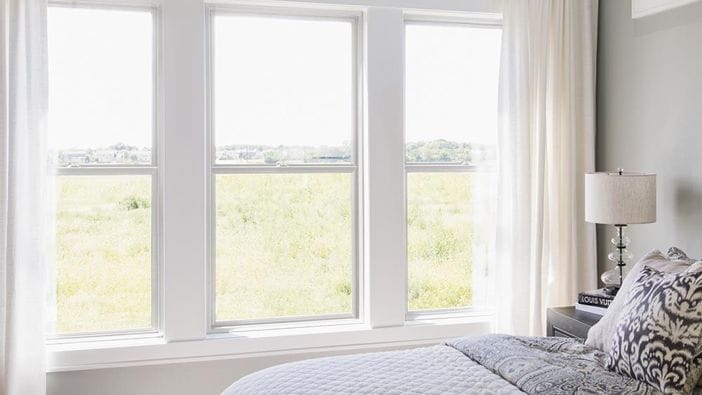
What Are the Parts of a Window Frame?

Regardless of the type of windows you’re replacing, it’s important to know the key parts of a window frame before you learn how to size a window. Window manufacturers typically use the following terms when specifying the measurements needed for a proper fit. Understanding these terms will help you measure accurately and ensure you purchase the right replacement windows the first time.
- Head: The head, also called the header, is the horizontal component at the top of a window frame. It runs across the top ends of the two jambs (defined below).
- Jambs: The jambs are the vertical frame elements on either side of the window frame.
- Sill: The sill is the bottom horizontal part of a window frame. It spans the base of the side jambs and supports the lower window sash — the framed portion of the window that holds the glass and may move up and down or swing open. The bottom edge of the lower sash rests against the sill when the window is closed.
How to Measure for Relacement Windows
You’ll want to take the following window size measurements for each window you plan to order. A Lowe’s associate can use these measurements to help you find the right windows for your openings.
Don’t have time to do this project yourself? Lowe’s can help. Check out our professional window replacement and installation service.
Step 1: Measure the Window’s Width

To find a window’s width, measure between the jambs at three points: top, middle and bottom of the window opening. Use the smallest of these three measurements when ordering the window.
If you have more than one window in the same room, for best results, always measure each window independently. Although two or three windows in the same room may appear to be identical, they may not have the exact same dimensions.
Watch our video How Do I Use a Tape Measure? for tips on taking accurate measurements.
Step 2: Measure the Window’s Height

To find a window’s height, measure from the high point of the sill of your window (the surface that’s closest to the inside of the window) to the top of the window opening. Take three measurements: one at the left side, one at the center and one at the right side of the window. Use the smallest of these three height measurements when ordering the window.
Step 3: Measure the Window’s Depth

Measure the depth of the existing window frame to make sure there’s enough room for a replacement window. Open the window and measure from the inside edge of the interior stop to the inside edge of the exterior stop (see illustration). These stops are the trim pieces that help hold the window sash in place. Don’t include pulleys, tracks or parting strips in your measurement because those parts are typically removed during installation. Most replacement windows require at least 3-1/4 inches of frame depth between the interior and exterior stops for a proper fit.
Step 4: Check for Square to Confirm Measurements
Measure from a top, inner corner of the frame — where the head meets a jamb — diagonally across the opening to a bottom, inner corner — where the opposite jamb meets the sill — and note the measurement. Measure diagonally from the other top corner to the other bottom corner. Compare the measurements. Replacement windows will typically allow for these measurements to be different by up to 1/4 inch.
If the diagonal measurements of the windows are different by more than 1/4 inch, you may need to note a larger width measurement. To calculate the adjusted width, run a level vertically along the inside of the frame, from the top to bottom of one of the jambs. Keeping the level within the frame, adjust it until it indicates a plumb line with the plumb bubble centered between the lines in the indicator window. Note the distance you had to move the level to achieve the correct plumb. Add this number to your smallest width measurement to get the adjusted width measurement.
Need to measure for new construction windows? We have a how-to that can help.
Expert Tips on Window Measurements and Replacement
- Choosing the correct replacement windows requires precise measurements to ensure a perfect fit. Make sure the measurements of the windows are accurate before ordering new ones or attempting installation.
- After you’ve taken your measurements, record them and keep them handy.
- Before you attempt to replace your windows, make sure the window frames are in good condition. As you remove the old windows, look out for rot, brittle wood or water damage.
- Consider replacing your windows with energy-efficient windows to save on your energy bill and increase your home’s resale value.
Window Replacement and Installation Services

If you’re ready to take on window replacement as your next DIY project, save time and money by taking accurate window measurements before placing your order. However, if you’d prefer not to tackle the task yourself, let Lowe’s do the work for you.
Our professional window replacement and installation service can handle everything from measuring to installation, and it all starts with a free consultation. Or stop by your local Lowe’s and speak with a Lowe’s Red Vest associate who’ll help you get started.