

Before You Start Planting Grass Seed

If you’re learning how to plant grass seed, you should know a few basic things first.
- A healthy lawn needs good soil. Most turfgrasses prefer soils with a neutral pH. To be sure that your efforts aren’t in vain, always perform a soil test first and make the recommended amendments.
- Feed your new grass with a starter fertilizer for lawns. The nutrients in starter fertilizer encourage the grass seed to germinate properly and quickly develop a root system.
- Don’t apply a weed preventer when seeding grass. You should only control weeds after you’ve mown new grass seedlings at least four times. Any weed preventer applied when you sow seed will prevent germination or kill immature seedlings. Our times. Any weed controls applied when you sow seed will prevent germination or kill immature seedlings.
When using lawn treatments or lawn-care products, always follow package directions regarding proper clothing, protective equipment, application procedures and safety precautions.
Selecting the Best Grass Seed for Your Yard

Before seeding, first identify the type of turf currently growing in your lawn. If you’re starting from scratch, select a turf type suited to your region and remember the specific requirements for your yard.
Grass seed labels describe specific care requirements — such as light tolerance, hardiness and resistance to drought — for that particular species of grass. Turfgrasses are either cool-season grasses or warm-season grasses. In general, where you live determines your lawn type.
Cool-season grasses are suited for areas shaded in blue on the map. Warm-season grasses grow well in the areas shaded in brown. In the green transition zone, blends or mixes of warm- and cool-season grasses are sometimes required. Normally, the transition zone has more success with the cool-season grasses over the warm-season varieties. Additional factors — such as altitude, the amount of sun and shade, degree of foot traffic, and availability of water — affect the success of a turfgrass variety. See our guide Choose the Right Grass for Your Lawn to learn about different types of grass seed.
Warm-Season Grasses
The major warm-season varieties are Bahia, Bermuda, centipede, St. Augustine and zoysia. If you decide to go with Bermuda grass seed, check out our Bermuda Grass Buying Guide. Here are some quick facts about growing a warm-season grass:
- Should be seeded from March through September, depending on your specific location and weather patterns
- Need hot summers and mild winters
- Grow during summer
- Go dormant in fall and winter
- Thrive in temperatures above 80 degrees Fahrenheit
- Need less water in general than cool-season grasses, making them more drought tolerant
- Tend to have wide, coarse blades
- Should be mowed close to the ground
- Are often overseeded with annual grasses for year-round color
- Are usually creeping varieties
Cool-Season Grasses
The major cool-season varieties are Kentucky bluegrass, fine fescue, tall fescue and ryegrass. See our article to learn when to seed and fertilize cool-season turfgrasses. For excellent results, keep in mind that cool-season grasses:
- Are seeded mid-August through mid-October, depending on your specific location and weather patterns
- Thrive in regions where winter temperatures reach below freezing
- Grow during spring and fall
- Go dormant in summer
- Thrive in temperatures from 60 degrees Fahrenheit
- Have long, fine blades
- Are maintained at a higher mowing level than warm-season grasses
- Are generally bunch varieties
What a Grass Plant Looks Like
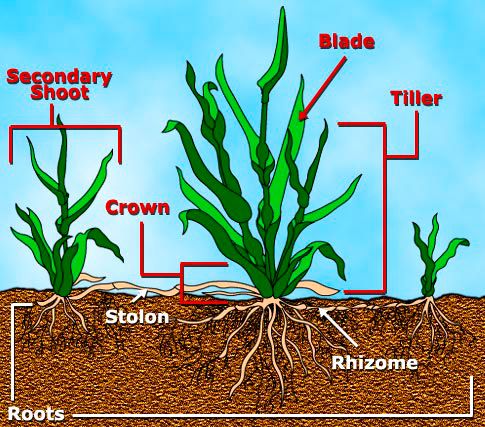
Creeping grasses, like Kentucky bluegrass and most warm-season grasses, spread by above- or below-ground runners. Bunch grasses, such as fescue and ryegrass, spread from the crown of the plant. Mow these varieties high to protect the crown and help ensure the grass’ survival.
The Composition of a Grass Plant
Blade: What most of us call a blade of grass is actually a complex combination of the grass stem, sheath and nodes. If it grows tall enough, a seed head develops.
Crown: This is the base of the grass where all new growth originates.
Rhizome: This is a horizontal below-ground stem or runner. Creeping grasses are spread by rhizomes or stolons.
Roots: This is the below-ground system that sustains the grass. Water and nutrients are absorbed by the roots.
Seed Head: This is the flower of the grass plant.
Stolon: This is a horizontal above-ground stem or runner. Creeping grasses are spread by stolons or rhizomes.
Tiller: This is made up of leaf blades and sheaths, the stem, and sometimes a seed head. They grow from the crown of the plant. Bunch grasses spread by producing new tillers.
How to Read Grass Seed Labels

State laws require labeling on grass seed. Be sure to carefully note the following information on the label:
- The amount of the named variety by percentage of weight
- Other crop seeds in the package by percentage of weight
- Any inert ingredients in the package by percentage of weight
- Percentage of weed seed in the mixture, if any
- The germination rate of the seed — a higher number means a better chance that each seed will germinate
The seed packaging should also tell you drop-rate settings for different spreader models. In addition to reading the label, you’ll need to determine how much seed to buy for your yard. Lowe’s Grass Seed Calculator can help you estimate this.
Seed Blends and Mixes
In addition to pure seed options, blends and mixes are also available. A blend is a combination of two or more cultivars of the same species — for example, two types of fescue. A mix is a combination of different species of grasses. Both blends and mixes are formulated for specific regions and needs, using the most desirable traits of each grass type to improve the lawn.
Other Considerations
- Apply the seed with a broadcast spreader or hand spreader. The coverage rates vary based on the type of seed you choose.
- Consider how you use your lawn. If you have a lot of foot traffic or children playing, look for a lawn seed with a high traffic tolerance. Play areas, especially under swings and other equipment, also need a tougher turf.
How to Seed a New Lawn

Seeding is the most common method of planting turfgrass. We list the general steps for seeding a lawn below, but some types of grass have specific planting and care requirements. Follow all the label’s instructions for your particular seed.
Step 1: Prepare the Ground and Add Nutrients

Dig or till the ground to a 3-inch depth. Rake to remove clods and smooth out the surface. Remember that you’re establishing a finished grade, so include any contours needed for drainage. Add compost, topsoil and starter fertilizer and then work them into the soil.
Step 2: Plant the Grass Seed
Spread the grass seed at the rate indicated on the packaging. To ensure even coverage, sow half of the seed in one direction and the other half in a different direction to make a crisscross pattern. Watch our video How Do I Use a Lawn Spreader? for tips on getting even coverage.
Rake the entire area again to cover the seeds with a small amount of soil. Mulch with a weed-free straw, such as wheat straw, or use an erosion control blanket to prevent the seed from blowing or washing away.
Step 3: Water and Mow the New Grass
Water frequently without saturating the soil to keep the seeds moist. Cut watering back to once a day when the grass reaches about 1 inch in height.
Mow when the grass reaches 2-1/2 to 3 inches. After you’ve mown three times, use a regular watering schedule of 1 inch per week. After mowing a minimum of four times, apply a crabgrass control product to stop the germination of unsightly crabgrass.
How to Overseed an Existing Lawn
Overseeding an existing lawn to fill it out or add green for the winter months follows the same basic principles as seeding a new lawn.

Step 2: Overseed With New Grass Seed
Spread the grass seed at the overseeding rate indicated on its packaging. Loosely rake in the seed. Top-dress with compost or peat moss.
How to Repair Bare Spots in a Lawn
Follow these steps if most of your lawn is in good shape and you just need to fix a few problem areas. If more than half your lawn is bare, consider starting a new lawn instead of relying on spot repair.
Step 1: Prepare Your Lawn for Repair
First, make sure the damage isn’t from pests. If you suspect an insect or animal is distressing your lawn, properly manage the pest before planting new grass. Then, remove dead grass and loosen the soil.
Step 2: Spread Grass Seed Over the Bare Spots

Spread grass seed with a push or hand spreader, noting our tips above for spreading grass seed. Next, rake it in.
Mulch with a thin layer of weed-free straw, such as wheat straw. As an alternative, you can use a seed starter mat or seed blanket to help keep the seed and loose soil from washing or blowing away.
How to Renovate or Reseed Your Lawn
If your lawn has extensive damage, you’ll need to get rid of any existing weeds and grass. Then, handle the project as if you’re starting a completely new lawn.
Step 1: Prepare the Lawn for Renovation
Mow lower than usual. Apply nonselective herbicide and let the product work by waiting 10 to 14 days or the amount directed by the product label.
Next, work compost, topsoil and starter fertilizer into the soil, as necessary.
Step 2: Reseed the Lawn
Seed as you would a new lawn using a hand or push spreader, sowing the seed evenly at the rate listed on the seed package. Remember to use a crisscross pattern: sow half in one direction and the other half in a different direction. Follow the remaining steps above in How to Seed a New Lawn.
How to Water New and Established Lawns

You must keep newly seeded lawns moist with light, frequent watering for the seeds to germinate. Don’t saturate the soil. Too much water can rot the seeds or wash them away. Continue watering just enough to keep the soil moist until the new seedlings are about 1 inch tall.
After your grass is established, follow these tips to keep your lawn adequately watered:
- Water in the early morning, if possible. The lack of wind minimizes evaporation and the chance for fungal diseases. However, if you see that the lawn or garden is becoming stressed or endangered from lack of water, go ahead and water without delay. Avoid watering with sprinklers on windy days.
- Water lawns irregularly rather than on a strict weekly schedule. This replicates natural weather patterns and helps make lawns more drought tolerant.
- Water deeply and allow the soil to dry slightly between waterings. This will help promote root growth. A strong root system creates hardier turfgrass. Light, shallow sprinklings evaporate before water can sink into the soil where it’s needed.
- Remove lawn thatch and aerate when needed to increase the soil’s water absorption.
- Locate and remedy any spots that are prone to runoff and erosion.
If you have an underground sprinkler system, maintain it and adjust it as necessary to provide the right amount of water at the right time.
Be sure to observe any water-use ordinances or restrictions for your area.
Start Your New Lawn With Lowe’s
Start a new lawn by choosing grass suited to your part of the country. Till the soil and add starter fertilizer and any amendments you need to give the new grass a good start. Spread the seed according to the coverage recommendations on the package. Water regularly to keep the soil moist until the grass reaches an inch in height. Don’t mow until the new grass is at least 2-1/2 inches high.
Shop for grass seed on Lowes.com by region, type, and sun and drought tolerance. Or visit your local Lowe’s to find grass seed that’s suited to your area. A Red Vest associate can help you pick the perfect grass seed, give you tips for seeding and make sure you have everything you need to start a beautiful lawn.