

What Is a Clamp?
A clamp is a tool that helps DIYers and pros:
- Hold workpieces together tightly until glue permanently joins them
- Secure a workpiece in place for safe, accurate work
- Support an item for hands-free work
Parts of a Clamp

Knowing the basic parts of a typical clamp helps you understand how these tools work and how to match their functions to your work:
- Jaws: The parts that directly touch the workpieces
- Bar or Body: The part that supports the jaws
- Throat: The open space created by the jaws and bar or body
- Clamping Mechanism: The component that brings the jaws together
Comparing Clamp Capabilities

These specifications give you common factors to compare different clamp types:
- Clamping Force: The maximum holding power a clamp applies
- Maximum Jaw Opening: The material thickness a clamp accepts
- Throat Depth: The material height or width a clamp accepts
The design of a clamp also affects its capabilities. For example, metal components typically mean more clamping force. Clamps with larger jaws distribute force more evenly for a better grip and less risk of damage.
Clamping a workpiece too tightly can damage or break the material. If the clamp begins to dent or warp the material, reduce the clamping force.
Types of Clamps
Most clamps share similar purposes and parts, but different clamps have different designs that determine their capabilities and uses. From different types of woodworking clamps to designs suited for metalworking and crafts, here are nine common clamp types, how they work, and what you use them for.
Bar Clamp

On a bar clamp, a sliding arm/movable jaw assembly travels along the bar and locks in place to hold the workpieces against a fixed jaw. Turning a threaded rod tightens the movable jaw against the workpieces or decreases the clamping force. A spring lever on the sliding arm allows you to quickly release the clamp. Bar clamps are also known as F-clamps or speed clamps.
Bar Clamp Features:
- High clamping power
- Fits different shapes
- Accepts a wide range of thicknesses
- Reduced damage risk with non-marring pads
Common Uses for Bar Clamps:
- Woodworking
- Metalworking
Parallel Jaw Clamp

A parallel jaw clamp functions like a standard bar clamp, with a bar, a fixed jaw, a sliding arm/movable jaw assembly and a release lever. However, the jaws are larger and, as the name indicates, they remain parallel to each other, helping keep the workpieces squared. Typically, you can reverse the sliding arm so the device can work as a spreader to keep workpieces separated.
Parallel Jaw Clamp Features:
- High clamping power
- Even pressure distribution
- Reduced damage risk with non-marring jaws
Common Uses for Parallel Jaw Clamps:
- Woodworking
- Cabinetry
- Furniture making
- Wood laminating and veneering
C-Clamp

A metal body or frame forms the throat and fixed jaw on a C-clamp. A threaded rod fitted with a pivoting jaw runs through the frame, tightening the workpieces against the fixed jaw or reducing the clamping force.
C-Clamp Features:
- High clamping force
- Fits different shapes
- Strong and durable
- Economical
Common C-Clamp Uses:
- Metalworking
- Welding
- Woodworking
- Automotive projects
- General DIY work
Trigger Clamp
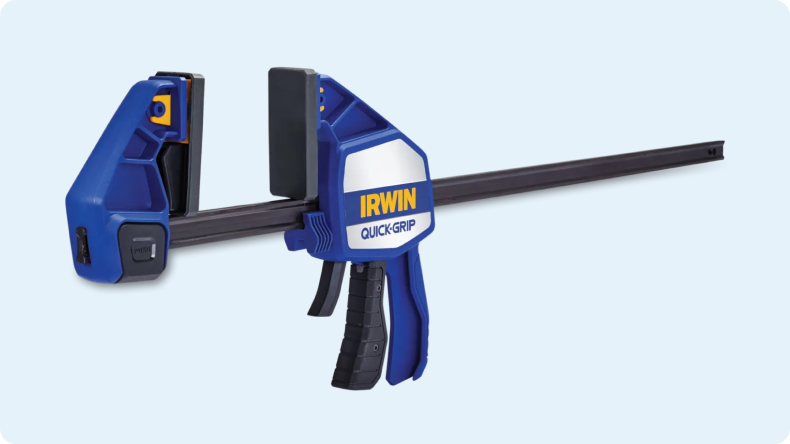
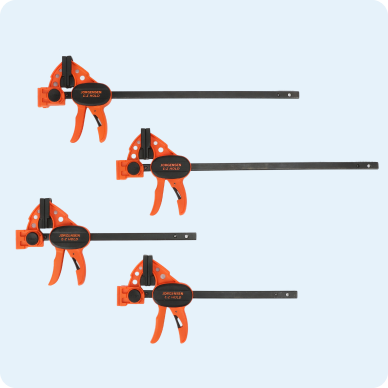
A trigger clamp features parallel jaws like a parallel jaw clamp. The sliding arm/movable jaw assembly travels along the bar to hold the workpieces against the fixed jaw at the end of the bar. A trigger ratchets the sliding arm along the bar to increase or reduce the clamping force. The sliding arm is usually reversible, allowing for use as a spreader.
Trigger Clamp Features:
- One-handed operation
- Even pressure distribution
- Reduced damage risk with non-marring pads
Common Uses for Trigger Clamps:
- Hobbies
- Crafts
- Model making
- Light woodworking
Spring Clamp

As the name implies, a spring clamp relies on a built-in spring for clamping power. Squeezing the handles opens the clamp, while releasing them clamps the workpieces together. The clamping power on this type isn’t adjustable since it depends on the strength of the spring.
Spring Clamp Features:
- Fast, one-handed operation
- Economical
Common Spring Clamp Uses:
- Hobbies
- Crafts
- Model making
- Light DIY projects
Ratcheting Hand Clamp

A ratcheting hand clamp has a design like a spring clamp but it’s adjustable and doesn’t use a spring to secure items. Pressing the handles together locks the jaws against the workpiece and determines the clamping force. A lever releases the clamp to adjust the clamping force, reposition the clamp or remove it.
Ratcheting Hand Clamp Features:
- Fast, one-handed operation
- Jaws stay square to each other
- Fits over obstacles
- Fits different shapes
Common Uses for Ratcheting Hand Clamps:
- Crafts
- Hobbies
- DIY projects
- Light woodworking
Face Clamp

A face clamp has a jaw and throat design like a ratcheting hand clamp. The handles lock the jaws onto the workpieces, while a screw on one handle adjusts the clamping pressure. A quick-release lever opens the jaws to reposition or remove the clamp.
Face Clamp Features:
- One-handed operation
- High clamping force
- Evenly distributes pressure
Common Uses for Face Clamps:
- Joinery
- Woodworking
Face clamps are particularly useful when creating pocket-hole joints. See our tips for using a pocket-hole jig to learn the basics of this type of joinery.
Angle Clamp/Corner Clamp

Angle and corner clamps hold two workpieces together at a 90-degree angle. A threaded shaft moves one jaw to apply and adjust the clamping force that holds the pieces against the fixed jaw. This type of clamp typically has screw holes or included C-clamps to secure it to a work surface.
Angle Clamp/Corner Clamp Features:
- Secures butt joints, miter joints and, depending on the design, T-joints
- Leaves the joint visible to allow nailing or stapling
Common Uses for Angle/Corner Clamps:
- Woodworking
- Joinery
- Cabinetry
- Frame making
Pipe Clamp

A pipe clamp set turns a spare metal pipe into a clamp. The fixed jaw and sliding arm components fit onto a length of pipe. The sliding arm moves along the pipe to engage the workpiece. A threaded rod turns the movable jaw to increase or decrease the clamping force.
Pipe Clamp Features:
- Works with nearly any size workpiece
- Available for different pipe diameters
Common Uses for Pipe Clamps:
- Woodworking
- Metalworking
- General DIY


Key Points for Choosing Clamps
Keep workpieces secure or allow glue to set properly for strong joints with the right clamps. Choose the best clamp for your project by remembering these points:
- Clamping force and capacity are key factors in choosing clamps.
- Larger clamps and clamps with metal components are usually stronger.
- Large jaws distribute pressure evenly, reducing the risk of damage.
- Most clamps can increase or decrease clamping force.
Stock your toolbox with a variety of clamp types and sizes so you always have the best tool for the work you’re doing. Shop for clamps on Lowes.com by type, size, clamping force, and price to find the right ones for your projects. Or visit your local Lowe’s and look at the available clamps. A Lowe’s Red Vest associate can help you find the best clamps for your work and make sure you have all the tools and materials you need for a successful project.
Clamps FAQ
Get tips for choosing and using clamps with the answers to these questions.
What Is a C-Clamp Used For?
Use a C-clamp to hold wood pieces together for gluing or to secure a workpiece for accurate and safe cutting, drilling, sanding or welding. The small, movable jaw on a C-clamp typically pivots slightly, allowing it to fit different shapes. However, it focuses clamping power on a small portion of the surface, so it’s not the best clamp to use on delicate or soft materials.
What Is the Difference Between C-Clamps and G-Clamps?
The terms C-clamp and G-clamp refer to the same type of clamp, reflecting the shape of the metal frame and the movable jaw assembly. A threaded rod turns to open or close the movable jaw, securing the workpieces and adjusting the clamping power.
What Is a Woodworking Clamp Called?
A woodworking clamp can be any clamp that holds wood pieces together for gluing, cutting, drilling, nailing or shaping. Trigger clamps, spring clamps, ratcheting clamps, face clamps, corner clamps and different types of bar clamps can all be woodworking clamps.
How Long Should You Leave Wood Clamped?
The clamp time for joining wood with glue depends on the adhesive and the application. The wood adhesive packaging should indicate the clamp time, which can be from 30 minutes to 24 hours or more. If the joint you’re gluing will be under stress during regular use, clamping time is longer. Follow the instructions for your adhesive.