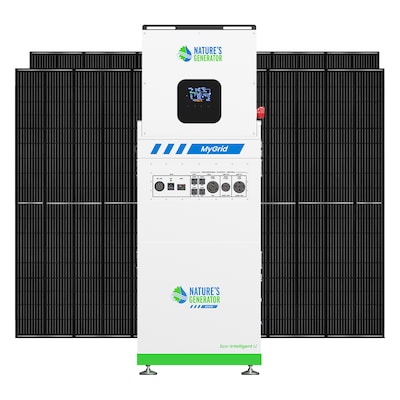
Power Your Adventures With an Off-Grid Solar System
There’s more to off-grid solar systems than just charging a phone or powering a light while you’re camping. Modern, portable solar systems give you the freedom to venture off the grid while also giving you peace of mind to get work done or enjoy the outdoors. These systems help to power equipment, tools, outdoor recreation gear and medical devices — such as continuous positive airway pressure (CPAP) machines — when you’re camping and don’t have access to regular power supplies.
An off-grid system differs from an on-grid one in that an off-grid system doesn’t connect to utility-supplied power. On-grid systems can draw power from city power lines, such as those that power most homes. Off-grid systems are entirely separate from the local electricity grid that a town, city or power company supplies. This means that, with an off-grid system, you can run your power tools for hours on a remote jobsite, or you can start to power your country home.
Off-grid solar systems use solar panels to create and store power. Solar panels create direct current (DC), but alternating current (AC) powers most of the everyday devices and equipment we use. To convert DC into AC, off-grid solar systems supply an inverter for solar panels.
Frequently Asked Questions
Q: What’s an off-grid solar inverter?
A: An off-grid solar inverter converts the DC from solar panels into AC to power your equipment and devices.
Q: Can a solar inverter work without a grid?
A: Yes, a solar inverter forms part of a solar power system. Solar inverters are necessary for solar systems to convert the DC from solar panels into AC.
Q: What kind of inverter do I need for off-grid power?
A: You need an inverter for solar panels to turn the DC that solar panels generate into AC to power household devices, tools and appliances.