

Which Vent Is Right for You?
Vents are designed to push warm or cold air through specific areas in the home. With so many different types and styles of vent covers available, how do you choose the one that’s right for you? Different types of vent covers serve various functions, but they’re all designed to regulate airflow and keep your rooms comfortable. Some even serve as decorative accents.
Finding the right vent cover depends on its placement, function and your personal style. Read on to find out more about the different types of vent covers and which one suits your space.
Registers

Registers are louvered vents on floors that are attached to ductwork openings and control the airflow into a room. They allow you to adjust the airflow volume and direction of the air with a damper, an attachment located below the vent cover. They can be installed in floors to allow heated air to rise in a room or in ceilings and walls for the flow of cold air.
Registers are either flush mount or self rimming. You should purchase them based on your duct opening size. Ideally, flush mount registers are installed at the same time as your flooring for an enhanced, uniform look.
In addition to the floor, registers can also be placed on sidewalls and ceilings.
For more information on floor registers, see our Decorative Floor Register Buying Guide.
The register size is based on the duct opening size, not the existing register. Measure the length and width of the opening and purchase or order your register based on these measurements.
Grilles

Like registers, grilles are also attached to ductwork openings, but they function differently. Unlike registers, grilles take the air out of a room and return it to your heating and air conditioning system. They don’t contain dampers, nor are you able to regulate the airflow. Grilles come in a variety of sizes and can be placed on a floor, a wall or a ceiling. They can also help to keep air filters securely in place.
Ceiling Diffusers
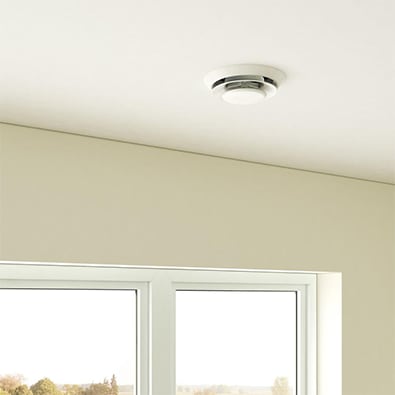
Ceiling diffusers are like registers in that they direct airflow into a room. However, you get up to a 360-degree airflow with ceiling diffusers. They work with your air conditioning ductwork or heating ventilation to deliver and distribute airflow evenly throughout the room. Without a diffuser, the air would flow straight down, with a concentration of cool or warm air going into one space.
Ceiling diffusers are available in several types. These include step-down diffusers that have layered rings to emit air uniformly throughout the room, as well as 2-way, 3-way and 4-way diffusers that release air on two, three or four sides, respectively. The 4-way diffusers work well when the ducts are in the center of the ceiling.
Baseboard Registers and Diffusers

Baseboard registers are designed to allow air to flow through the ducts for heating and cooling. They’re placed in baseboards over ductwork that’s slender and long. A baseboard register is about half as wide as a normal floor register.
Baseboard diffusers let you control the direction of the airflow into a room. Like a ceiling diffuser, baseboard diffuser dampers face in different directions, giving you better disbursement of air throughout the room. A volume control damper allows you to increase or decrease the airflow as needed.
Materials
Registers, grilles and diffusers come in a variety of materials and finishes so that you can blend them seamlessly into the space. Choose the color that complements your room or select one that’s paintable or stainable for a custom look.
Registers
For durability, the best choice for registers is a material like steel, cast iron or aluminum. These are the most common materials for registers, and they’re also fire retardant. Flush mount wood registers add an elegant touch, especially when used with hardwood flooring to create a complementary, integrated and finished look. Humid conditions can cause metal registers to rust, so ABS resin — also known as plastic — floor registers work well in high-moisture areas, such as bathrooms and kitchens.
Registers can be installed on a variety of flooring, including hardwood flooring, carpeted flooring and tiled flooring. They’re available in a variety of finishes — such as black, brown, white, bronze and more — to coordinate with your flooring.
Grilles
Grilles can also be integrated into a room to coordinate with the space. They’re made of durable steel, wood and aluminum, among other materials. The typical finish for a grille is white, but they’re also available in brown and other colors.
Ceiling Diffusers
Aluminum is one of the most used materials in a ceiling diffuser, along with galvanized steel and steel. ABS resin is another common material.
Baseboard Registers and Diffusers
For durability, baseboard registers and diffusers are commonly crafted from steel. You’ll sometimes find them made of wood as well.
Frequently Asked Questions About Vent Covers
Are vent covers universal or do I need a specific size?
Vent covers are not universal. They are sized to fit specific duct openings, so you’ll need to choose one that matches your duct dimensions.
How do I measure for vent covers?
Measure the length and width of the duct opening, not the existing vent cover. Vent sizes are based on the duct opening.
Can I replace vent covers myself?
Yes. With the correct size, most vent covers can be installed on floors, walls or ceilings and are suitable for DIY replacement.
How often should vent covers be cleaned or replaced?
Vent covers should be kept clear of dust and debris to allow proper airflow. Replace them if they become damaged, rusted or no longer fit correctly.
How do I improve air flow through my vent covers?
Use the correct size vent cover and consider registers with adjustable dampers to control airflow direction and volume.
What is the best material for vent covers in a humid area, like bathrooms?
ABS resin vent covers are a good choice for humid areas since metal options can be prone to rust.
Get Started on Your Project
Choosing the right vent cover helps control airflow, improve comfort and complement your space. Vent covers come in different types, including registers, grilles and diffusers, and are sized to fit specific duct openings. Materials range from metal and wood to ABS resin, with some options better suited for high-moisture areas. Features like adjustable dampers allow you to direct and manage airflow where you need it most.
Shop Lowes.com for vent covers in a variety of sizes, materials and styles or visit your local Lowe’s and talk to a Red Vest associate. They can help you find the right vent cover and make sure you have what you need for a smooth installation.