
The Importance of High-Quality Kitchen Knives
Every professional chef has a personal set of knives that they use and meticulously care for. Knives are the tools of a chef's trade, but they can be an equally important tool in your home kitchen. Using the correct knives and keeping them regularly sharpened can make food prep easier and safer. A dull blade is more dangerous than a sharp one since it requires more pressure to cut through food, increasing the probability that your knife will slip and have more force behind it. A sharp blade will more easily bite the surface of the food you’re cutting.
How Often Should You Replace Your Kitchen Knives?

Ideally, you shouldn’t have to replace your knives often. If you sharpen your knives regularly and they don’t have any structural issues, then you can continue using them indefinitely. You should replace a knife if you detect defects such as noticeable chips in the blade, a bent or broken tip, a loose handle or loose rivets. You may simply find that the knife is generally difficult to work with. If your knives won’t stay sharp, they may be of low quality, and it might be a good time to invest in better options.
To keep your knives in top shape, sharpen them once or twice a year. Over-sharpening the blade can ruin it since sharpening removes a thin layer of the blade’s material. Wash and dry your knives after every use, always use them on a cutting board and don’t use them to cut frozen food. Treat the blades of your knives with mineral oil to prevent rust. You can also apply the oil to wooden handles to keep them in good condition.
How Many Kitchen Knives Do You Really Need?
The number of knives you need in your kitchen depends on the cooking techniques you use, the kinds of foods you need to cut and how often you cook. Every kitchen should contain a chef’s knife, a paring knife and a serrated knife, as these can act as multi-purpose knives. More avid home chefs may require more specialized knives for certain preparatory needs. A cutlery set will typically include a chef’s knife, paring knife, serrated bread knife, a utility knife and a set of steak knives.
Types of Kitchen Knives

- A chef’s knife is the backbone of your kitchen arsenal and suitable for almost any cutting task. A good chef’s knife will have a sturdy handle and curved blade that you can rock against a cutting board. Santoku knives have a slightly different shape but work for similar tasks.
- For cutting fruits and vegetables, a 3- to 4-inch long paring knife is ideal. These are lightweight, comfortable and very sharp with a defined tip.
- Also commonly known as a bread knife, a serrated knife can cut through baked goods without squashing the softer inside of foods like loaves of bread or cakes. These knives have long, narrow blades and serrations in the blade.
- A carving knife is about 8 inches long and thinner than a chef’s knife. It’s ideal for making thin, precise cuts in roasted meats.
- Utility knives are thinner than chef’s knives and may or may not have a serrated edge. These are useful for various cutting tasks.
- Steak knives are a good tableware staple to have, especially if the flatware knives you have aren’t sharp enough for certain foods. At least part of the blade is typically serrated.
-
Cleavers are 7-inch striking knives, easily identifiable by their wide width. They're used for butchering purposes since they easily sever bones and joints.
- To be used in tandem with a cleaver, a boning knife is 5 inches long with a thin blade that can easily be maneuvered around bone and joints when butchering meat.
- Slicing knives are thin, flexible knives, typically 7 to 10 inches long. They're good for sweeping cuts and fileting meat.
What Should Your Kitchen Knives Be Made Of?

The two main factors that will affect the price and the durability of your kitchen knives are the material they’re made of and the way they are made. The size of your budget and what you plan to use your knives for will help you determine what kinds of knives make sense for you.
Materials
- Stainless steel: The most common blade material, stainless steel, resists corrosion. Lower grades are softer and need to be sharpened more often.
- High-carbon stainless steel: These steels have a higher carbon content than typical stainless steels, making them stronger and allowing their blades to remain sharp for longer.
- Carbon steel: Carbon steel is non-stainless steel with a carbon content of around 1%. Carbon steel knives are budget-friendly and keep their edge, but they are susceptible to stains.
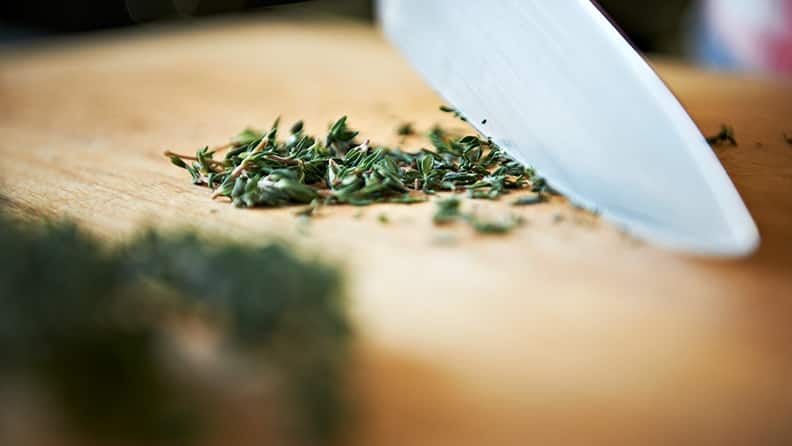
- Ceramic: Ceramic blades are exceptionally hard, lightweight and sharp. They’re great for cutting fruits and vegetables, but not as good for meats. Ceramic is more brittle than steel, and while it can hold an edge for a long time, it's harder to sharpen once it becomes dull.
Construction
- Forged: Forged blades are made from a single piece of steel that is heated and then shaped, heated again, cooled quickly, tempered, polished and sharpened. These thicker, heavier blades are usually considered the best kitchen knives and are priced accordingly.
- Stamped: Stamped blades are made in a machine where they're cut from a piece of steel and heat-treated before being ground, polished and sharpened. The blades are thinner and lighter. They're usually a less expensive option.
Ergonomics
If a kitchen knife is uncomfortable for you to hold or use, there’s a greater chance that you might cut or injure yourself with it. When holding a knife, the handle should keep your hand and wrist in a neutral position