
Tools and Materials
Items may be Special Order in some stores. Product costs, availability, and item numbers may vary online or by market. Paint colors may vary slightly from those shown. Availability varies by market for lumber species and sizes.

- Build a DIY funhouse mirror using a simple wood frame, Plexiglas and mirrored window film for a spooky Halloween decoration.
- Bend the flexible mirror inward or outward to create different distortion effects, making reflections appear taller, slimmer, wider or larger.
- Follow step-by-step instructions to assemble the frame, apply the mirror film and install the curved mirror panel.
- Add the finished mirror to a haunted house or Halloween party display for an interactive decoration that surprises guests.
How to Build Your Own Haunted House Mirror
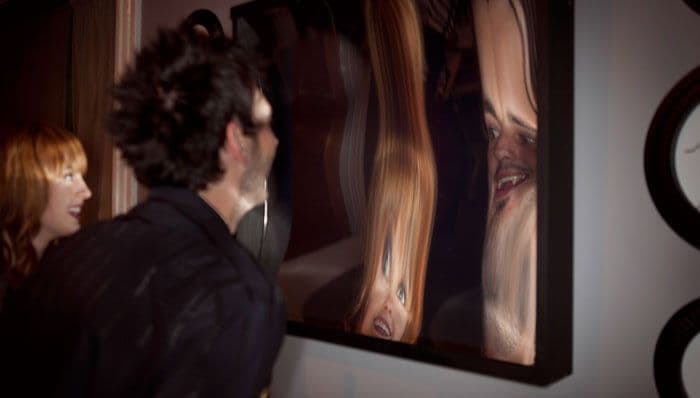
Mirror, mirror on the wall, who is the scariest one of all? Build this spooky funhouse mirror and let the reflective fun begin! A slight bend inward slims and lengthens your reflection. A slight bend outward adds width and heft.
Step 1
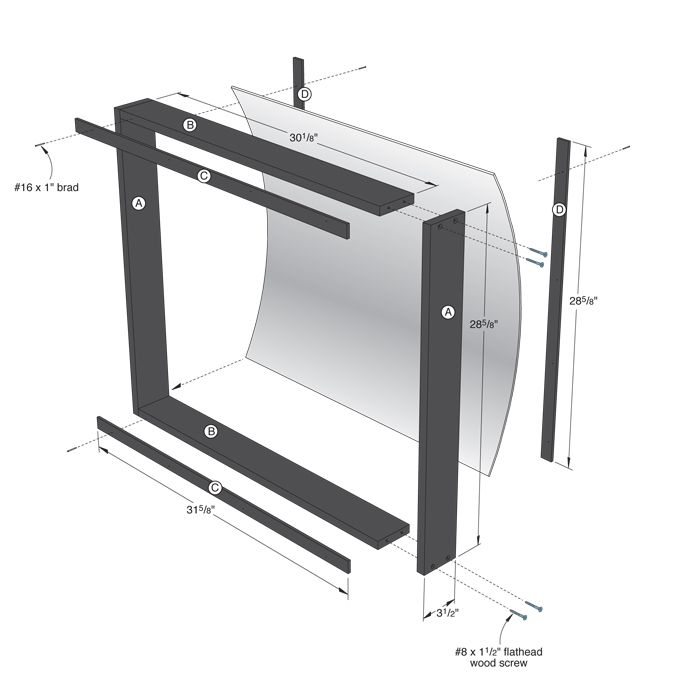
Cut the 1"x4"x10' board to create one 1"x4"x61" section and one 1"x4"x59" section (or ask a Lowe's Associate to cut it).
Step 2
From the 1"x4"x61" section, cut 2 boards (B) to 30-1/8 inches. From the 1"x4"x59" section, cut 2 boards (A) to 28-5/8 inches.
Step 3
Using wood glue and #8 wood screws, butt joint the boards so that the 28-5/8-inch boards (A) overlap the ends of the 30-1/8-inch boards (B).
Step 4
Cut 2 pieces of lattice to 31-5/8 inches (C). Using wood glue and 1-inch brads attach the lattice pieces horizontally to the front edge of both of the 30-1/8-inch boards (B).
Step 5
Cut 2 pieces of lattice to 28-5/8 inches (D). Using wood glue and 1-inch brads attach the lattice pieces vertically to the back edge of both of the 28-5/8-inch boards (A).
Step 6
Paint the entire wooden frame black. Let dry.
Step 7
Follow directions included with the window film and application kit and carefully apply the window film to the Plexiglas sheet.
Step 8
Carefully bend the Plexiglas sheet and insert it between the lattice edges (C) and the boards (B). An inward bend slims and lengthens your reflection. An outward bend adds width and heft.